Estate Planning & Administration
Intestacy: What Happens Without a Will
Last updated February 2026
2 min read
✓ Verified Feb. 2026
Roughly two out of three American adults do not have a will. When a Pennsylvania resident dies without one, the estate doesn't go to the government (a common myth). It goes to relatives in a fixed order dictated by 20 Pa.C.S. §§ 2101 to 2114. You don't get to choose. The statute chooses for you.
The result is often not what the decedent would have wanted. The intestacy formula is mechanical. It doesn't account for estranged children, a partner of 20 years who isn't a legal spouse, stepchildren you raised as your own, or the sibling who cared for you versus the one who didn't speak to you for a decade. Everyone in the same category gets the same share, period.
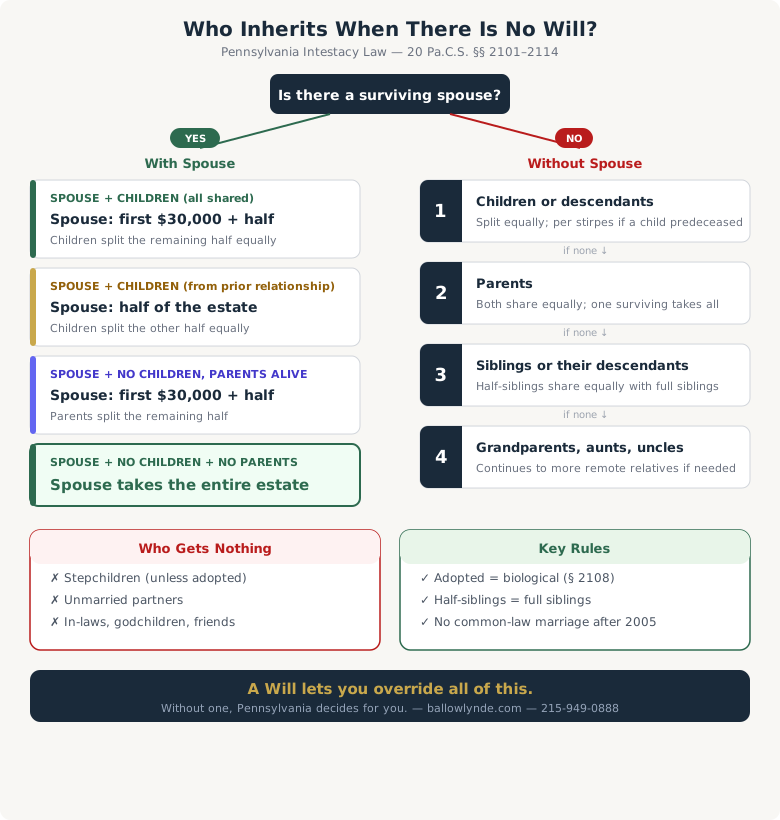
Pennsylvania's intestate succession follows a strict hierarchy. The surviving spouse receives the entire estate only if there are no children and no surviving parents. If the decedent had children who are also children of the surviving spouse, the spouse receives the first $30,000 plus half the balance, the children split the rest. If any children are from a prior relationship, the spouse receives only half, no $30,000 credit. If there is no surviving spouse, everything goes to children in equal shares. If no children, to parents. If no parents, to siblings. The statute continues through increasingly remote relatives before the estate passes, under Act 50 of 2025, to an endowed community fund in the decedent's municipality, school district, or county; and only if no qualifying fund exists does the estate escheat to the Commonwealth (§ 2103(a)(6)). True escheat is extremely rare.
Two critical points people miss: first, the intestate share is calculated on the probate estate only. It does not include life insurance, retirement accounts, jointly held property, or anything with a beneficiary designation. Those assets pass outside probate regardless of the intestacy rules. Second, the personal representative of an intestate estate must still go through the full probate process. There is no shortcut because there's no will.
Tap your family scenario below to see exactly how a $200,000 estate would be divided under Pennsylvania law.
With a $200,000 estate, the spouse receives $30,000 off the top, then half of the remaining $170,000 ($85,000); totaling $115,000. The children split the other $85,000. Two children would each receive $42,500.
20 Pa.C.S. § 2102(3)
When any child is not also a child of the surviving spouse, the $30,000 credit disappears. The spouse receives exactly half. $100,000. All children (from this marriage and prior relationships) split the other $100,000 equally.
20 Pa.C.S. § 2102(4)
Same formula as the married-with-children scenario: the spouse receives $30,000 plus half of $170,000 = $115,000. The parent(s) receive $85,000. If both parents survive, they split it equally ($42,500 each). If only one parent survives, that parent takes the full $85,000.
20 Pa.C.S. § 2102(2)
This is the only scenario where the surviving spouse receives everything. No children, no surviving parents, the spouse inherits the full $200,000. Siblings, nieces, nephews, none of them receive anything.
20 Pa.C.S. § 2102(1)
Children divide the estate in equal shares. Two children: $100,000 each. Three children: $66,667 each. If a child predeceased the decedent but left children of their own (grandchildren), those grandchildren take their parent's share by representation (per stirpes). An unmarried partner, even of 30 years, receives nothing.
20 Pa.C.S. § 2103(1)
If both parents survive, they split equally. $100,000 each. If one parent survives, that parent receives the full $200,000. A long-term partner, close friends, or charities you supported, none inherit without a will.
20 Pa.C.S. § 2103(2)
Siblings divide the estate equally. Two siblings: $100,000 each. If a sibling predeceased the decedent, that sibling's children (nieces/nephews) take their parent's share. If there are no siblings or their issue, the statute moves to grandparents, then aunts and uncles, then first cousins; continuing outward until a relative is found. In default of all relatives, the estate passes under § 2103(a)(6) to an endowed community fund in the decedent's municipality (first priority), school district, or county. Only if no qualifying fund exists does the estate escheat to the Commonwealth.
20 Pa.C.S. § 2103(3) to (6)
Important: These rules apply only to the probate estate. Life insurance, retirement accounts, jointly held property, and accounts with beneficiary designations pass outside of probate, the intestacy statute does not control them.
Statutory content on this page was last verified against Pennsylvania statutes (20 Pa.C.S.; 72 P.S. Art. XXI): February 2026. If you are reading this significantly after that date, confirm key provisions with current statute text or contact our office.
Free consultations available for most practice areas.
Book a Free Consultation Or call 215-949-0888