Estate Planning & Administration
Beneficiary Designations: The Documents That Override Your Will
Last updated February 2026
8 min read
✓ Verified Feb. 2026
This is the estate planning mistake that causes the most damage, and most people don't realize it until it's too late.
Certain assets pass outside your will entirely , directly to whoever is named as the beneficiary on the account. These assets include:
Your will has zero effect on these assets. If your will says "everything to my children equally" but your 401(k) still names your ex-spouse as beneficiary, your ex-spouse gets the 401(k). Period. No court will override a valid beneficiary designation based on a contradictory will.
Pennsylvania law (20 Pa.C.S. § 6111.2) provides that a divorce automatically revokes any beneficiary designation in favor of the former spouse for life insurance, annuities, retirement accounts, and other non-probate transfers. The assets pass as though the former spouse predeceased the decedent .
Sounds like a safety net. It isn't.
Here's the problem: ERISA preempts state law for employer-sponsored retirement plans. The U.S. Supreme Court held in Egelhoff v. Egelhoff (532 U.S. 141, 2001) that a state revocation-on-divorce statute cannot override a beneficiary designation on an ERISA-governed plan. This means if your ex-spouse is still named as beneficiary on your 401(k) or employer pension, Pennsylvania's automatic revocation does not apply , and your ex-spouse collects the full account. The plan administrator follows the beneficiary form, not state law.
The Supreme Court further validated state revocation statutes in Sveen v. Melin , 584 U.S. 488 (2018), holding that retroactive application of such statutes does not violate the Contracts Clause. But the ERISA preemption from Egelhoff remains: state revocation statutes cannot override beneficiary designations on employer-sponsored retirement plans.
⚠ The Most Common Disaster Scenario
Parent gets divorced, updates their will to leave everything to their children, and assumes the divorce "took care of" the old beneficiary designations. It didn't at least not for the 401(k). The ex-spouse collects $500,000 from the retirement account. The children get whatever's left in the probate estate, which might be the house and a checking account. I see some version of this scenario multiple times every year, and by the time the family calls us, it is too late.
When an account has no valid beneficiary because the named beneficiary predeceased the decedent, or the beneficiary form was never completed, the account typically defaults to the estate . That sounds fine, but it creates two problems:

The Setting Every Community Up for Retirement Enhancement (SECURE) Act of 2019 fundamentally changed how inherited retirement accounts are taxed. Before the SECURE Act, most individual beneficiaries could "stretch" required minimum distributions (RMDs) from an inherited IRA or 401(k) over their own life expectancy, sometimes decades. That stretch is gone for most beneficiaries.
Under current rules, most non-spouse beneficiaries who inherit a retirement account must withdraw the entire balance within 10 years of the account owner's death. This is the "10-year rule," and it means significantly accelerated taxation. A $500,000 inherited IRA that could once be stretched over 40 years of a young beneficiary's life expectancy must now be emptied in 10, potentially pushing the beneficiary into much higher tax brackets.
A narrow group of beneficiaries, called eligible designated beneficiaries , can still stretch distributions over their life expectancy instead of being subject to the 10-year rule:
Surviving spouses. A spouse has the most flexibility. They can roll the inherited account into their own IRA, treat it as their own, delay RMDs until the deceased spouse would have turned 73, or use the life expectancy method. This is the one beneficiary category where the old rules essentially still apply.
Minor children of the account owner (not grandchildren). Minor children can use the life expectancy stretch until they reach the age of majority , at which point the 10-year clock starts. Under IRS regulations, "age of majority" is 21 for this purpose. So a child who inherits at age 10 stretches until 21, then must empty the account by age 31.
Disabled individuals. A beneficiary who meets the IRS definition of disability (unable to engage in substantial gainful activity due to a medically determinable condition) can use the life expectancy method indefinitely. This intersects directly with special needs trust planning.
Chronically ill individuals. Similar to the disability exception, beneficiaries who are chronically ill (unable to perform at least two activities of daily living for at least 90 days, or requiring substantial supervision due to cognitive impairment) qualify for the life expectancy stretch.
Beneficiaries not more than 10 years younger than the account owner. A sibling, partner, or friend who is close in age can still stretch. This exception rarely applies to the typical parent-to-child inheritance.
The SECURE Act makes the choice of beneficiary far more consequential than it used to be. Naming your 35-year-old child as the beneficiary of your $800,000 IRA now means they will owe income tax on all $800,000 (plus growth) within 10 years of your death. If that child is a high earner, the combined tax hit could exceed 40% of the account.
Planning strategies that respond to the 10-year rule include Roth conversions during your lifetime (so the beneficiary inherits tax-free), naming a charitable remainder trust as beneficiary for very large accounts, and considering whether a trust as IRA beneficiary serves your goals (it adds complexity but can provide control over distribution timing and protect against creditors or divorce). SECURE 2.0, enacted in 2022, made further adjustments including raising the RMD age to 73 (and eventually 75) and expanding Roth options in employer plans.
⚠ Trust Beneficiaries and the 10-Year Rule
If you name a trust as your IRA beneficiary, the trust's classification matters enormously. A conduit trust (which requires all RMDs to be distributed to the beneficiary immediately) and an accumulation trust (which allows the trustee to hold distributions inside the trust) produce very different tax outcomes under the 10-year rule. Accumulation trusts that hold inherited IRA distributions face the compressed trust tax brackets: the highest federal rate kicks in at roughly $15,200 of income. See our conduit vs. accumulation trust article for the full analysis.
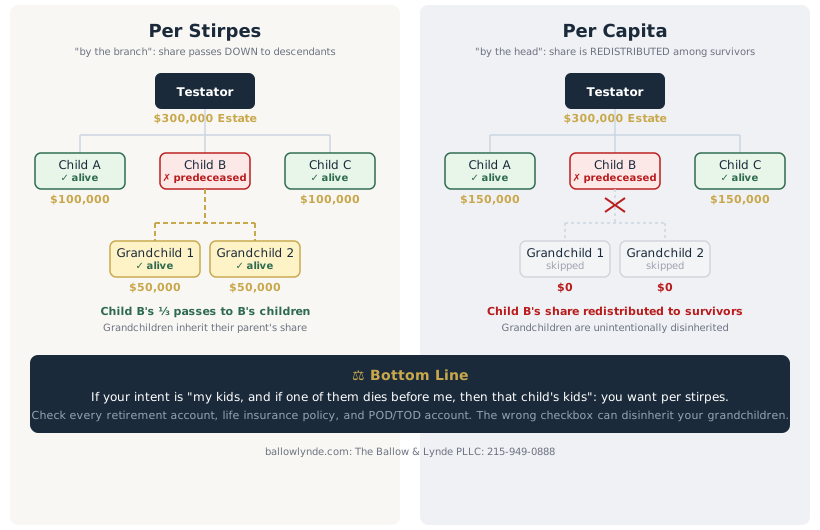
When naming multiple beneficiaries (typically children), the beneficiary form usually asks you to choose between " per stirpes " and " per capita " distribution. Most people check one without understanding the difference, and the difference matters enormously if a beneficiary predeceases you:
If your intent is "my kids, and if one of them dies before me, then that child's kids," you want per stirpes . If the form doesn't say, and the default is per capita , your grandchildren could be unintentionally disinherited.
Pennsylvania's slayer statute (20 Pa.C.S. § 8802) provides that a person who is responsible for the death of the decedent forfeits all rights to any benefit from the decedent's estate, including beneficiary designations. The assets pass as if the killer predeceased the decedent. This applies to life insurance, retirement accounts, joint accounts, and all other non-probate transfers.
Every estate plan should include a beneficiary designation audit . Pull the current beneficiary forms for every retirement account, life insurance policy, annuity, and POD/TOD account. Compare them to your estate plan. Update any that are outdated, name a deceased person, or conflict with your current wishes. Check the per stirpes / per capita election. And do this again every time there is a major life event; marriage, divorce, birth of a child, death of a beneficiary.
Special Situations
If your beneficiary is a minor: The insurance company or plan administrator cannot distribute funds directly to a minor. Name a trust or custodial arrangement, not the child directly, to avoid a court-supervised guardianship. If your beneficiary has a disability: A direct inheritance will disqualify the beneficiary from SSI and Medicaid. Name a third-party special needs trust as beneficiary, not the individual. These are the situations where a $300 beneficiary designation review prevents a $10,000 problem.
Statutory content on this page was last verified against Pennsylvania statutes (20 Pa.C.S.; 72 P.S. Art. XXI): February 2026 . If you are reading this significantly after that date, confirm key provisions with current statute text or contact our office.
Free consultations available for most practice areas.
Book a Free Consultation Or call 215-949-0888